UBone3D: Physics-Rectified Conditional Flow Matching for Anatomical 3D Shape Completion from Ultrasound

This page is under construction.

1University of Alberta, Edmonton AB, Canada 2ShanghaiTech University, Shanghai, China
Accepted by ECCV 2026

Abstract

Three-dimensional ultrasound (US) is a safe, radiation-free complementary modality to CT and X-rays for longitudinal monitoring, yet its segmentation-derived partial point clouds are extremely artifact-laden. Consequently, it is challenging to recover a clean and complete anatomical structure from such US point clouds. In this paper, we present UBone3D, a novel framework based on physics-rectified conditional flow matching (CFM) that performs point cloud completion directly from partial US observations. UBone3D models deterministic physics artifacts (e.g., surface thickening, streaking, dropouts) via a simulated physics proxy, and introduces test-time physics rectification to steer the shape completion. At inference, the completion is jointly steered by two decoupled forces: (1) anatomical plausibility enforced by a CT-trained generative shape prior, BoneFM, and (2) physics consistency enforced by USimNet in the ultrasound formation space. Extensive experiments on simulated and in-vivo data demonstrate significant improvements in reconstruction accuracy and anatomical fidelity over existing baselines.

Method

UBone3D reframes ultrasound bone reconstruction as conditional point cloud completion. A conditional flow matching model transports a noisy point set toward a complete bone shape conditioned on the partial US observation. At test time, the trajectory is rectified by two decoupled guidance forces:

  • BoneFM — a CT-trained generative shape prior that enforces anatomical plausibility, pulling the completion toward the manifold of realistic bone geometry.
  • USimNet — a differentiable ultrasound-formation model that enforces physics consistency, ensuring the completed shape re-explains the observed US artifacts (thick surfaces, streaks, dropouts) in the ultrasound formation space.

By decoupling where the anatomy should be from what the ultrasound physically measures, UBone3D recovers clean, complete, and anatomically faithful bone shapes without requiring paired CT supervision at inference.
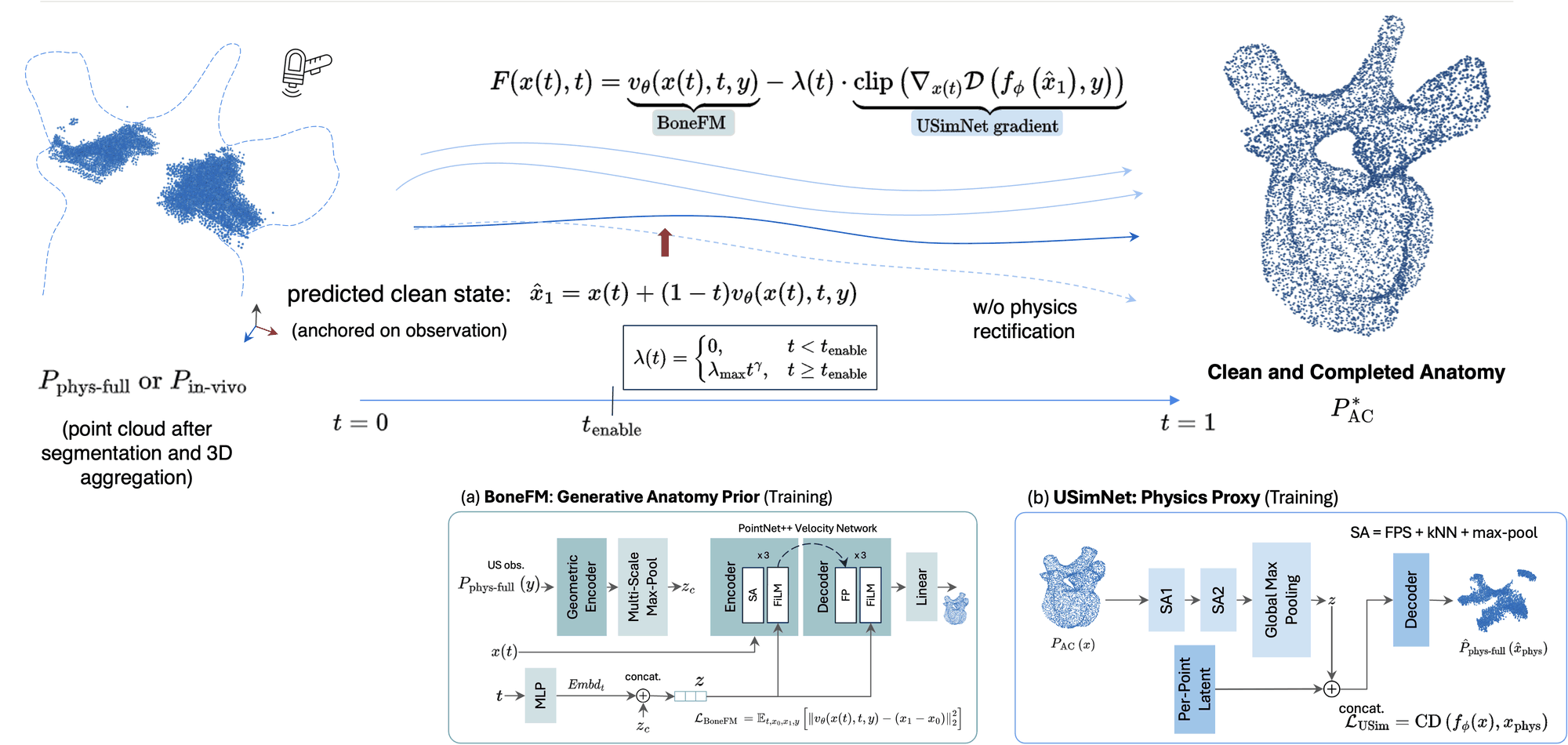
UBone3D overview: a conditional flow matching trajectory from t=0 to t=1 rectified by a BoneFM velocity term and a clipped USimNet gradient, with sub-diagrams for (a) BoneFM training and (b) USimNet training.

Results

Qualitative and quantitative comparisons on simulated and in-vivo data show consistent gains in reconstruction accuracy and anatomical fidelity over existing baselines.

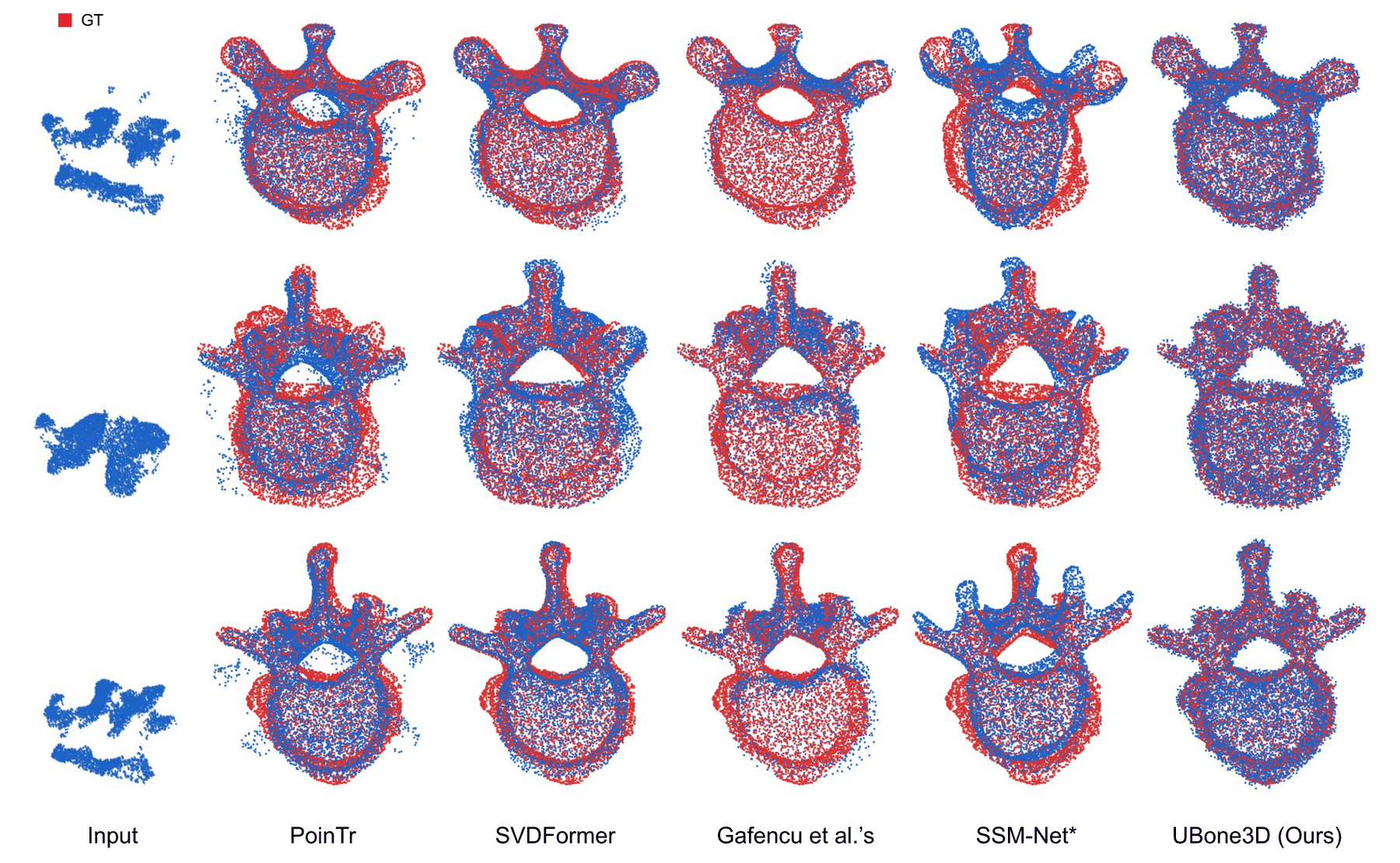
Qualitative comparison on simulated ultrasound point clouds: input, PoinTr, SVDFormer, Gafencu et al.'s, SSM-Net* and UBone3D (ours), with ground truth overlaid in red.
Qualitative comparison on simulated ultrasound point clouds. Ground truth is overlaid in red; UBone3D (rightmost) recovers complete, anatomically faithful vertebrae from severely incomplete inputs.
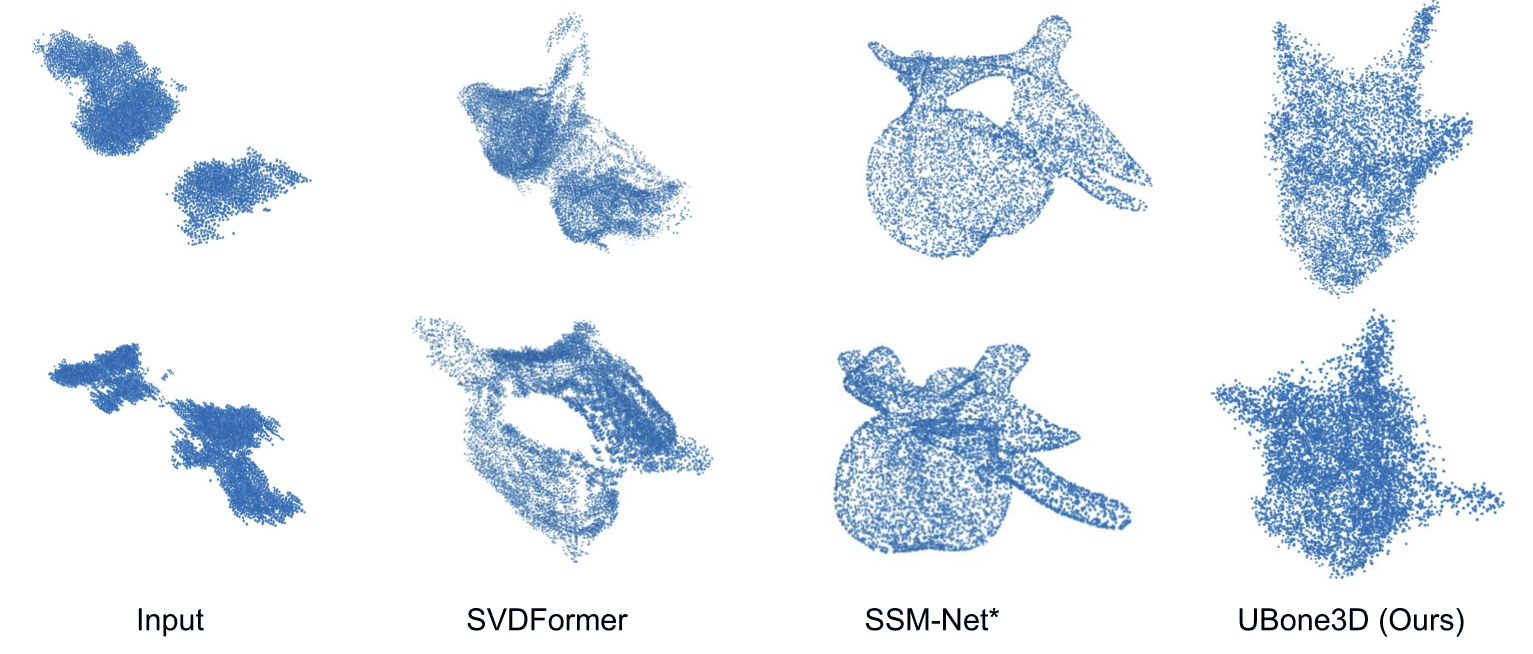
Qualitative comparison on in-vivo ultrasound point clouds: input, SVDFormer, SSM-Net* and UBone3D (ours).
Qualitative results on in-vivo ultrasound scans, where no ground truth is available.